

Cryoablation, the process of destroying tissue with ultra-low freezing temperatures, is being used around the world to treat a growing number of clinical indications. In many cases, the driving force behind a novel use of cryoablation is driven not by researchers or physicians, but by the patients themselves. In this blog, we highlight the case of a patient who was the victim of a terror attack and sought out cryoablation for pain palliation.
Terror Victim Searching for a New Form of Pain Reduction
79-year-old Toky was the victim of a terror attack in January 1968 when he was living in Ein Yahav near the Israel/Jordan boarder. Toky recounts, “terrorists penetrated our community from Jordan and shot me in both legs. A bone was broken in my leg, and the nerves were damaged, leaving me 100% disabled.”
For many years, Toky did not experience any pain in his damaged legs. But 45 years after the incident, he began to have pain in his feet. He explains, “The pain started mainly when lying down and before going to sleep so I started taking sleeping pills.” As time progressed, Toky experienced pain every day, which was exacerbated by lying down. The resulting discomfort and lack of sleep had a significant detrimental effect on his life.
Toky was not prepared to accept that pain would be part of his ongoing life. Initially he tried peripheral alcohol injections for pain relief. When this treatment was discontinued, he searched for an alternative.
He recounts, “I heard about cryoablation when I saw an article on TV about a 102-year-old woman who underwent the procedure for breast cancer. She was the first breast cancer cryoablation patient in Israel.
After I saw the article on TV, I looked for the doctors who performed it and found Dr. Halpern from Bnai Zion Medical Center. I called him the same day and told him ‘Listen, I saw the article and I have a problem with chronic leg pain. I want you to try to numb the pain with cryoablation.’”
Liquid Nitrogen Based Cryoablation
Dr. Yair Halpern is Head of the CT (computed tomography) unit at the Bnai Zion Medical Center in Haifa, Israel, and an expert in diagnostic and interventional radiology. As an experienced user of the ProSenseTM Liquid Nitrogen Based Cryoablation System, Dr. Halpern has been involved in the clinical use of cryoablation or various indications, including breast and kidney. He has also welcomed clinicians from around the world interested in learning the latest applications of cryoablation.
Dr. Halpern explains, “Hundreds of cryoablation treatments for cancerous tumors in various organs, such as kidney tumors, bone tumors, etc., have been successfully performed at the Bnai Zion Medical Center. Now we are starting to use the same technology of freezing tumors in the treatment of breast cancer. We are constantly finding new possible uses for cryoablation treatment in a wide variety of diseases and conditions.”
Innovative Cryoablation Treatment
Dr. Halpern was initially surprised by Toky’s request. “At the time, I had not explored cryoablation in this form of palliative care.” However, with such a determined patient and compelling story, Dr. Halpern agreed to meet with him and explore the potential treatment options.
Toky presented with a painful peripheral nerve in his right foot. The leg was already swollen with long term damage that did not respond to traditional treatments. “Cryoablation has also been proved to have efficacy as a pain palliation in other areas of the body” Dr. Halpern explained. “This made me think that there was a case to treat Toky’s foot as an initial singular trial into the use of cryoablation for this type of pain reduction.”
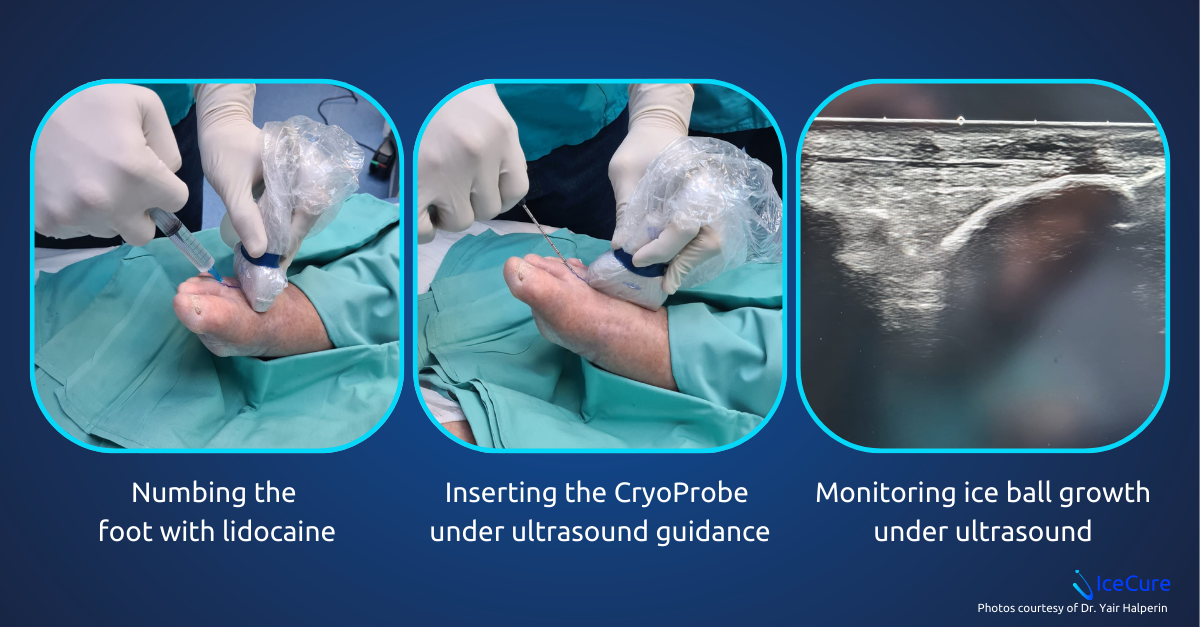
The procedure took place at Elisha Medical Center in Haifa, in December 2022. Dr. Halpern modified the standard cryoablation protocol to fit the case. “Since we were treating an area 5mm from the skin, I performed very short freeze/thaw cycles, of approximately 1 minute each.” (Standard care for internal cryoablation typically varies from 5 -10 mins per step.) In this specific case, the unique capability of cryoablation to access body structures with precision allowed Dr. Halpern to accurately freeze the nerves causing pain.
Immediate Pain Reduction With Cryoablation
Very shortly after the procedure, Toky reported pain reduction after a few days. After the success of the initial treatment, another area in his leg was treated in a second procedure. Toky reports, “In the two areas that we did the cryoablation, I remain almost entirely pain free, where previously I was in so much pain that I had considered amputating my leg.” No complications or adverse events were reported.
Dr. Halpern stresses that this is an isolated case performed under special permission from the Israeli Health Authority for scientific research as cryoablation does not yet have clearance as a treatment for pain palliation in extremities in Israel.*
The Science Behind Cryoablation for Pain Palliation
Although the use of cryoablation for pain palliation in cases such as Toky’s is still relatively new, there is a considerable body of evidence towards to the use of cryoablation in other areas of pain palliation.
Cryoablation is effective in pain reduction by blocking nerve signals along peripheral pathways, creating a reduction of pain in the treated area. The procedure is performed by inserting a cryoprobe into the affected area under the guidance of ultrasound or CT imaging. An ice ball is generated using temperatures as low as -170℃ (either through the insertion of liquid nitrogen or high-pressure argon gas into the cryoprobe.) This ice ball destroys the tissue, killing the targeted cells, and deadening nerve endings.
The wider application of cryoanalgesia—employing cryoablative techniques for pain reduction—has found a number of clinical uses. It allows clinicians to disrupt nerve structures to manage pain effectively while preserving the outer tissue layers.
There has been extensive research into the efficacy of cryoablation in pain palliation. In 2009, Campos, Chiles and Plukket found that ultrasound guided cryoablation of the genitofemoral nerve reduced inguinal pain. Similarly, in 2013, Connelly et al reported that long term relief of symptoms from established, chronic pain conditions was achieved through cryoablation with ultrasound guidance.
To date, cryoablation for pain palliation in the management of bone metastasis has been one of the most popular applications, as it allows for the management of pain without the side effects found in other methods. One study found that cryoablation was associated with a 44.2% improvement in quality of life after 4 weeks and 59.6% after 8 weeks. Patients were able to reduce opioid usage with 75% reduction at 24 hours post cryoablation and 61.7% reduction from pre-cryoablation opioid levels at 3 months.
A Bright Future for Cryoablation
As Toky’s case demonstrates, there is still much to explore in the use of cryoablation for a wide range of indications. Thanks to early adopters such as Dr. Halpern, patients and clinicians have a potential for new treatment choices, through the power of cryoablation.
*Disclaimer: IceCure has regulatory approvals worldwide and clinical indications may vary by region. Please contact us for additional information.